

Greetings Friend, and welcome to my QRZ Info Page!
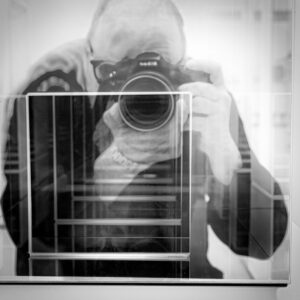
After a very long break from all-things ham, I am greatly enjoying my return to amateur radio, and experiencing how much things have changed over the years. Right now is a remarkable time to explore the possibilities of SDR and ham radio–all the while meeting new friends and reconnecting with old. A look at my old “heavy metal, ham salad days” can be seen at the very bottom of this page. Here I am working street photography in Lower Manhattan, December 2024
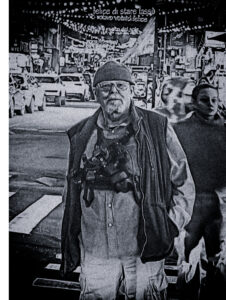 |
| Here I am working street photography in Lower Manhattan, December 2024 |
More about my journey may be found in the Brief History section below.
► QTH WEATHER REPORTING STATION
My weather station is an Ambient Weather WS-2902 unit known as “The Osprey”, due to its shape. It’s mounted alongside the ‘Rabbit Ranch’ at an elevation of 18′ (~4.6m). Click on the link below for live weather info:
► STATION INFORMATION
- Icom IC-7300 SDR Transceiver
- SDRPlay RSP1B SDR Receiver
- Baofung BF-F8HP (comms-crosslink)
- LDG AT-100Pro Autotuner
- N7DDC AT-100EXT Autotuner + Daiwa CN-101 Analog SWR/Power Monitor (for experimental/novelty antennas)
- CQV SWR-508 Digital SWR/Power Monitor
- Surecom SW-102 VHF/UHF Digital SWR/Power Monitor
- QJE PS30SWI 30A DC Power Supply
► RADIO SOFTWARE
- Ham Radio Deluxe v6.9.x (HRD, Logbook, DM780)
- SDR Console v3.4, SDR Trunk v0.6.1
- Simon’s World Map v1.5.4
- Netlogger v3.1.7
► AUDIO CHAIN
- Icom HM-219 electret condenser stock mic
- Heil ICM-BG electret condenser boom mic
- Shure SM57 cardiod dynamic mic
- Heil Pro Set Elite iC headseet electret condenser mic
- Astatic DN-HZ unidirectional dynamic mic (TUP-9 base)
- Pyle PMX44T.5 Mix/Preamp board
► ANTENNAS
- 134′ Doublet, 120′ 450Ω window line to 1:1 current balun @ ~55′ AGE, east & west broadsides
- 130′ 80/20% OCF, W2FMI 4:1 current balun @ ~45′ AGE, north & south broadsides
- 33′ 40-6M End Fed to 9:1 Unun with counterpoist @ 40′ AGE, east & west broadsides
- Diamond X200A 2M/70CM Vertical @ 40′
- Various experimental concoctions–flavor of the day…
► COMPUTING SUPPORT
- MSI MPG Z490 GAMING EDGE WIFI (MS-7C79) Motherboard
- Intel i7-10700K Comet Lake Core Processor
- G.Skill DDR4-3200/PC4-25600 (64gb) SDRAM
- NVIDIA GeForce RTX 5060 Ti (16Gb DDR5 SDRAM) GPU
- Microsoft Windows 11 Professional
- 4 Monitors: 1X 32″ 4K; 1X 27″8K; 2X Asus ProArt 24″
- Cyberpower 1350AVR UPS
► QSL INFORMATION
⇒ QSL through eQSL and QRZ Logbook Only
- I DO NOT participate in LoTW, Radio Sport or FT8 events–no exceptions.
- QSL reporting is uploaded as soon as I save the contact to HRD Logbook.
- If you send a paper card–I will enjoy it–but there will be no return mail response.
- If you send money, thank you for the beer
 .
. - Also, no live animals please--I am still dealing with the angry emu from the last time…
 |
 |
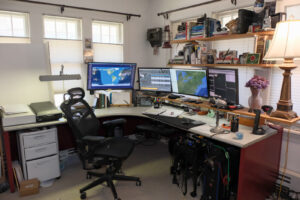
| This is the primary station for my studio office. Built of insanely heavy 80s Steelcraft office components, it serves as the hub for my photography atelier–and as a production center for various consulting and research projects. It is also a place of many random rabbit holes, time portals, and interesting idle pursuits…
Unseen are photographic duplication and large format color printing work areas. The goal was to unobtrusively include my ham experience into my daily life and varied worklife. Except for the monitor content, nothing seems to stand out strongly as ‘ham.’ Take a break, work a band—right? |
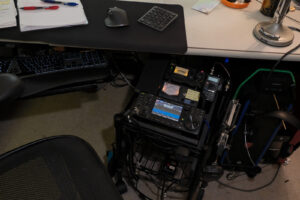
However, if I roll out this little, seriously re-tasked hanging file cart–I have a fairly self-contained amateur station (with antenna, rig and dummy load switching) AT MY FINGERTIPS that covers 80-6M, with excellent 2M/70CM connections via a Diamond X200A 2M/70CM Vertical @ 40′ AGL. The Diamond is also solid for piping public service frequencies to the SDRPlay.
For a small form factor deployment, this station supports DC to daylight through the SDR magic of an IC-7300; a RSP1B (on the cart); and a BF-F8HP. Special thanks go to the scores of dedicated engineers, scientists, hobbyists, coders, and companies who make all of this amazing stuff possible. |
► THE SHOP
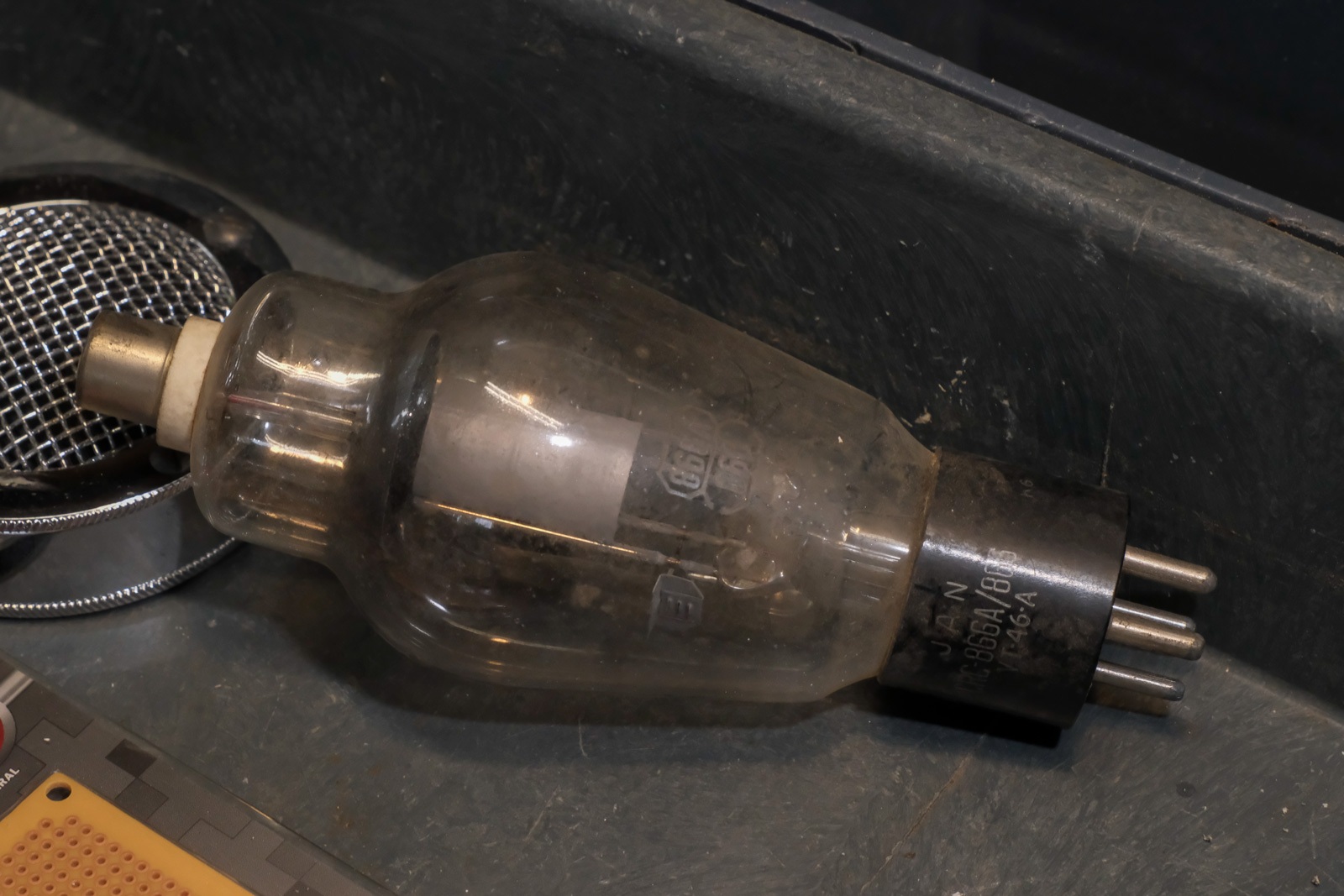
Virtually every tinkering-type ham has some sort of shop or fix-it area. Mine has evolved significantly in the past few years—transitioning from the classic linear, fixed bench stocked with many 80s high-tech wonders in various stages of failure–to something more precise, useful, and flexible. During the initial transition, I built one mobile solution reminiscent of the rolling service carts of my TV shop days—but with a small instrument rack!
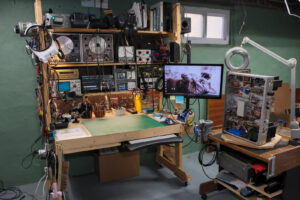
Pictured below is the humble evolution of 50 years creating my own personal electronics workspaces. Resource libraries, schematics, apps, and instrumentation are all supported through a recycled Dell Optiplex 7040SFF, provisioned by an Intel i5 processor, 32Gb RAM, and a 24″ FHD display on a pole. Keyboard is in a slide drawer. Repeated measurements and mockups were staged, and was refined to my hand and work habits. Regular hand tools are located to the left—small tools in stands. The shop area will remain in the basement, and maybe one day will change from Heathkit Green to something else. No, really not. Sounds like something for the next owner to worry about.
The adjacent rolling cart (a retasked 90s printer cart) I refer to as the ‘dissection cart’ , and it holds a rotating carousel, 1970s magnifying lamp, and a super versatile multi-position vise (thank you once again, Harbor Freight). At the bottom is a reconditioned Eico 667 dynamic tube tester on a sliding shelf, and a selection of T-Handle tools. A combination of old and new friends, these rolling wonders perfectly act as an extension of myself when working a project.
 |
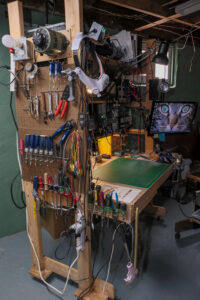 |
| A perfect assembly of moving solutions! Those projects that are important—and active—inhabit these two rolling workplaces.
As arrayed, this bench can work with vacuum tube or solid-state technologies. Investment has been made in essential test gear and tools for consumer radio, audio equipment, and B&W television. The remainder steps up to handle ‘new’ technologies with as much precision as I can personally manifest. Armed with multi-soldering capabilities—the space can handle pretty much everything I will ever throw at it. The older, linear workbench (not seen on the left) holds an array of parts, unusual tools, rarely used test equipment–and often a couple spent IPA bottles.. |
At the left are all common larger hand tools and solutions—including the fearsome Dremel tool.
Startup testing of repair items is accomplished through the Variac, a 150W incandescent lamp, and the voltage/ammeter seen in the small, aluminum Budd Box. Most everything commonly needed is within easy reach or a short roll of the chair. For me, this is the most functional and happy workspace in a lifetime of tinkering! When the time comes that this bench needs to leave the basement, it is easily accomplished. The benchtop is mounted on alignment blocks, and the removal of just 4 carriage bolts and the monitor pole allows it to be slid away–making for two conveniently transportable components. |
► BRIEF HISTORY
I recall when I spied the very new 1968 ARRL Handbook on the library shelf. It was the old Carnegie Library in Bradenton, Florida, and I knew the feel, smell, and contents of every book on that waxed oak shelf. The manual went home with me that day, and was renewed twice more—the limit a Junior Reader patron could hoard a book without being chastized and then made to sit it out for a month. Previous months had seen the same fate befall certain Robert Hertzberg W2DJJ books as well. All of this interest was the result of a summertime electronics program for kids held every Saturday morning at the Junior Science Museum. The teacher was a striking, older Hungarian man named Albert Kossa, WA4SXN (SK), who introduced himself in what sounded like one word, “alcossa.” Yup, Mr. Alcossa, the ham with the shock of black and white striped hair.
The real ‘showstopper’ of the manual for me was to be located on Page 2 of the catalog section—the Heathkit SB line of gear. (Click here to view an image) The price seemed reasonable, and I could put them together myself! Everyone was building Heathkits. The plan looks solid and satisfying, until we consider the fact that I was 11 at the time… But, then it was all about dreams, right?
As it does, life came along and I spent the next 40 years working around electronics and communications—but not ‘in’ amateur radio. I repaired many great old boatanchors, business/marine radios (even Children’s Band radios in the 70s) in various storefront TV & Radio shops (remember those?) in my own and those of others; I was surrounded by ham friends, but could not comprehend Morse code. Then finally came sad bellows from deep in the benthic ham sea, portending the “end of real ham radio” in February 2007.
Days later I tested straight into my General Class ticket and was pool assigned KI4UMG. Within two weeks of vanity filing, I had become N4PRT and entered the fray armed with an Icom IC-751A and a homebrew G5RV suspended 40’ AGL. What fun, and then onward to AE1PT after earning my Amateur Extra ticket in 2011! And note from the old photos, once the pressure was off I quickly learned to code. Go figure…
Having spent a decade carefully acquiring and reconditioning the pieces of my Heathkit dream station, running an Icom IC-751A, along with a Valiant/NC-303 combo that celebrated my birth year–I officially made my 10Kth contact on all of it—then turning off the big switch and walking away to find other pursuits. Segue several years forward, and I was finished with the rest of it. All the fun had finally run out…
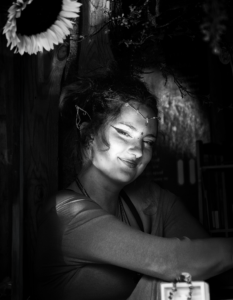
Foremost in this shifting time was the development of my creative photography practice. The result of that effort is my atelier, PapaTango Photography (please click the link to visit)
 |
 |
 |
 |
 |
 |
 |
I still dabble a bit in vacuum tube projects, and am busy exploring the different possibilities of software defined radio. My goals in this round of radio are much more laid-back, but no less ambitious. SDR gives me amazing tools to play with that just 20 years ago could only be imagined.
My interests do not lean toward fast paced contesting, canned macro exchanges, or full-on HRO operation. Casual and even-paced are the order of the day–along with a bit of obsessive experimentation and homebrew. I have designed my new station with compact efficiency—one that allows it to be integrated into the activities and resources of an already productive office and studio space. It will be perfect for nets and ragchew QSO’s, don’t you think—all the while lollygagging about in my favorite Herman Miller Ergo chair clone?
My wife, granddaughter and I claim a fief in the booming metropolis of Bath, NY—loudly and joyously occupying a sprawling old money pit made up of a cranky hundred-year-old house, four cats, two rabbits, a revolving cast of colorful characters; all situated in a yard that has gotten too damned big for my tastes. But then there are the antennas to consider…
This is my ham radio story, and I am sticking to it. Back to you, net control…
73, Pat “Papa Tango”
07/25/2026
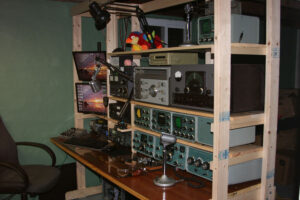
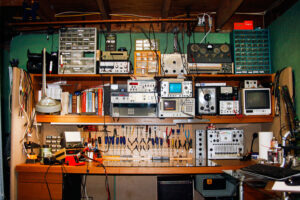
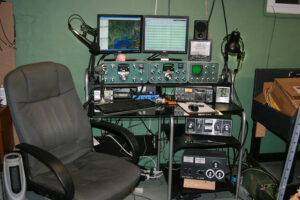
This was the setup of the old basement shack and shop in 2016. Many pieces have been sold and sent off to others. Other things await resurrection and sending off. My back hurts even looking at this stuff…
 |
 |
AND SOME THINGS REALLY FROM THE PAST…
 |
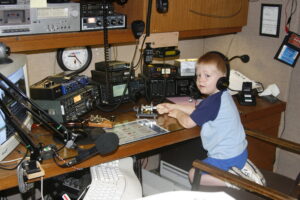 |
| 2013 Shack, New York | 2008 Shack, Kentucky [ KI4UMG >>> N4PRT ] |
 |
|